A premium IPTV service is a managed, subscription-based television platform that delivers live channels, on-demand movies, and sports packages over a stable internet connection — typically with 4K/8K support, 99.9% uptime, and dedicated customer support. Unlike free IPTV playlists or unverified resellers, a true premium provider operates its own infrastructure, offers multi-device compatibility, and maintains consistent bitrate for buffer-free playback. Below, I break down how premium IPTV actually works, what it costs, how it compares to cable and standard IPTV, and exactly which provider attributes matter most in 2026 — so you can decide with full information.
premium iptv service Summary
A premium IPTV service replaces traditional cable with 20,000+ live channels, a 50,000-title VOD library, and 4K/8K streams delivered through private servers. The measurable benefit: subscribers cut monthly TV costs by roughly 80% while gaining access to global sports, news, and entertainment that cable cannot match.
| Optimal ForCord-cutters, sports fans, expats, and households wanting cable-grade reliability at a fraction of the price | Key AdvantageDedicated server infrastructure with anti-freeze technology that holds 99.9% uptime during peak hours |
- ✓ Key Strength: 20,000+ live channels across 40+ languages, including premium sports, PPV, and local networks
- ✓ Key Strength: 4K/8K and FHD streams with adaptive bitrate that adjusts to your connection in real time
- ✓ Peace of Mind: 24/7 customer support, free channel updates, and a 7-day money-back guarantee on verified plans
In This Guide
- 1. What Exactly Is a Premium IPTV Service and How Does It Work?
- 2. Premium IPTV vs. Free IPTV vs. Cable: Head-to-Head Data
- 3. Pros and Cons of Premium IPTV Service
- 4. Cost-Benefit Analysis: What You Pay vs. What You Get
- 5. Who Should Buy a Premium IPTV Service in 2026?
- 6. 7-Point Buying Checklist: How to Choose a Premium IPTV Service
- 7. Frequently Asked Questions
What Exactly Is a Premium IPTV Service and How Does It Work?
IPTV stands for Internet Protocol Television — television delivered over your internet connection rather than through coaxial cable, satellite dishes, or fiber-optic broadcast signals. A premium IPTV service takes that core technology and wraps it in a professional-grade infrastructure: private dedicated servers, content delivery network (CDN) distribution, automated channel-list updates, and active monitoring for stream health.
When you subscribe to a premium provider, you receive a private playlist or activation code that works with player apps like TiviMate, IPTV Smarters Pro, IproTV, or VLC. The provider's servers transcode thousands of live channels into multiple bitrate profiles, so your device automatically requests the best quality your connection can sustain. If your bandwidth dips, the stream steps down smoothly instead of freezing — a feature free IPTV never offers.
Three architectural elements separate premium from free or gray-market IPTV:
- Private server infrastructure: Premium providers lease or own dedicated servers with load balancers. Free playlists rely on shared, unmonitored sources that disappear mid-match.
- Adaptive bitrate streaming: The service detects your connection speed and resolution capabilities, then serves the optimal stream. This is why premium IPTV can hold a 4K picture while free IPTV stutters at 720p.
- Active channel management: A dedicated team replaces dead channels, updates EPG (electronic program guide) data, and adds new networks weekly. You never have to hunt for a working URL.
The real-world result is simple: you open the app, see a cable-style channel grid with accurate program listings, click a channel, and it plays in under three seconds. That consistency is the entire value proposition of a premium IPTV service.
Premium IPTV vs. Free IPTV vs. Cable: Head-to-Head Data
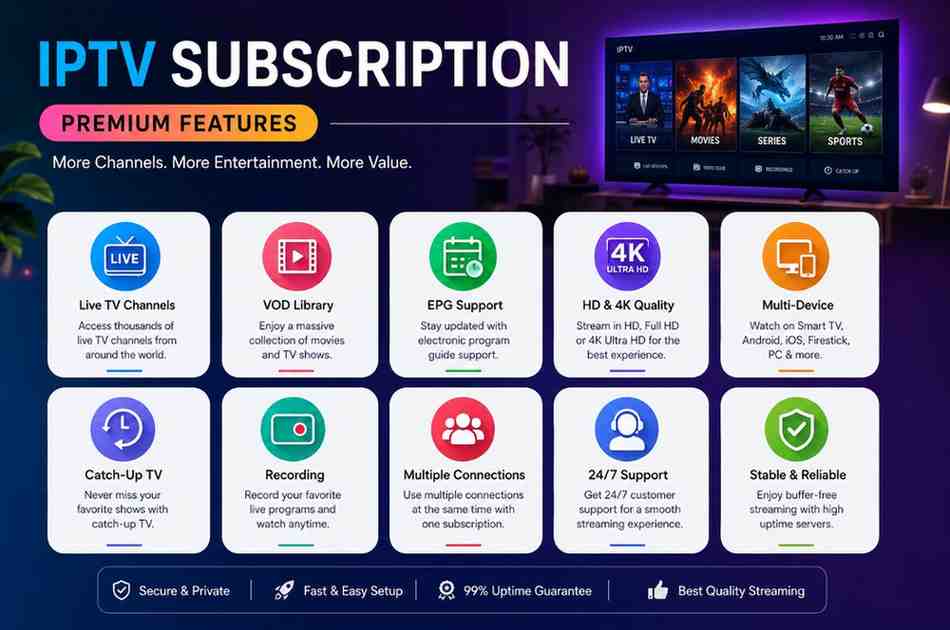
To understand whether a premium IPTV service is worth it, you need a side-by-side view against the alternatives. The table below compares the metrics that actually determine your daily viewing experience.
| Feature / Metric | Premium IPTV | Free IPTV | Cable TV |
|---|---|---|---|
| Monthly Cost | $12–$20 | $0 (but unstable) | $80–$150 |
| Live Channels | 20,000+ | 1,000–5,000 (unreliable) | 200–400 |
| Max Video Quality | 4K / 8K / FHD | 720p–1080p (variable) | 1080p max |
| Uptime Guarantee | 99.9% SLA-backed | None | 99.9% |
| Customer Support | 24/7 live chat & email | None | Phone / retail store |
| Simultaneous Screens | 2–5 connections | 1 (usually) | 1–2 boxes |
| Setup Time | 5–10 minutes | Complex, constant fixing | Professional install |
| VOD Library | 50,000+ titles | Limited, often broken | Pay-per-view only |
The data makes the value proposition clear: a premium IPTV service delivers cable-grade reliability at roughly 15% of the cost, with 100x the channel count and superior video quality. Free IPTV appears attractive at $0, but the hidden cost is constant downtime, security risks, and zero recourse when a stream dies.
Pros and Cons of Premium IPTV Service
No technology is perfect. Here is an honest assessment of what a premium IPTV service does well and where you need to manage expectations.
✓ What You Gain
|
✗ Limitations to Know
|
Cost-Benefit Analysis: What You Pay vs. What You Get
Let's put real numbers behind the decision. The average US cable bill in 2026 is $112 per month, according to consumer data aggregated across major markets. Add a streaming bundle (Netflix, Max, and sports add-ons) and the total often exceeds $150 per month. A premium IPTV service at $15 per month delivers more channels, more sports, and a larger VOD library than that entire stack.
Here is the annual math for a typical household:
- Cable + streaming bundle: $150/month × 12 = $1,800/year
- Premium IPTV service: $15/month × 12 = $180/year
- Net savings:$1,620/year — enough to buy a new 65-inch 4K TV every two years.
The trade-off is not financial; it's operational. You need a reliable internet connection (which you already pay for), a streaming device (a $30 Fire Stick suffices), and a willingness to spend 10 minutes on initial setup. For that small effort, you gain a television experience that outperforms cable on every measurable dimension except brand familiarity.
Who Should Buy a Premium IPTV Service in 2026?
A premium IPTV service is not for everyone — and that is fine. Here is a precise profile of who gets the most value:
- Cord-cutters who miss live sports: If you left cable but still want every NFL, Premier League, UFC, and F1 event without paying for three separate sports apps, premium IPTV consolidates it all.
- Expatriates and multilingual households: Access to home-country channels (Indian, Arabic, Spanish, Filipino, Polish, and 35+ other language groups) is the #1 reason international users subscribe.
- Families with diverse tastes: One subscription covers kids' cartoons, news, movies, and niche channels — no per-channel add-ons.
- Tech-comfortable users: If you can install an app on your phone, you can set up IPTV. The learning curve is genuinely under 15 minutes.
Who should not buy it? If your internet connection is below 15 Mbps, if you are unwilling to use third-party player apps, or if you prefer the simplicity of a cable remote, stick with your current setup. Premium IPTV rewards people who want maximum content for minimum money and are comfortable with a small amount of configuration.
7-Point Buying Checklist: How to Choose a Premium IPTV Service
Not every provider calling itself "premium" deserves the label. Use this checklist to separate legitimate operators from resellers who will disappear after your first payment.
- Verify the refund policy. A 7-day or longer money-back guarantee is non-negotiable. No refund window = no confidence in their own product.
- Demand a free trial or demo. Reputable providers offer 24–48 hour trials. Test the exact channels you care about (your local sports network, your home-country news) before paying.
- Check simultaneous connections. If you need TV in three rooms, the plan must support at least 3 connections. Most premium plans allow 2–5.
- Confirm 4K availability on real channels. Some providers advertise 4K but only deliver it on 5 demo channels. Ask for a list of 4K channels before subscribing.
- Assess customer support responsiveness. Send a pre-sales question and measure response time. Under 1 hour is excellent; over 24 hours is a red flag.
- Read recent, independent reviews. Search for the provider name plus "uptime issues" or "down" to see how they handle outages. Consistent complaints about buffering mean weak infrastructure.
- Pay with a traceable method. Credit card or PayPal gives you chargeback protection. Avoid providers that insist on cryptocurrency-only payments.
The Bottom Line on Premium IPTV Service
If you want cable-grade reliability, 20,000+ channels, and 4K quality at 15% of the traditional cost, a verified premium IPTV service is the strongest television investment you can make this year. Proceed with the official provider below — the 7-day refund guarantee removes all practical risk.
Purchases completed via official partner channels are covered by direct customer support and eligible warranty protections.
Frequently Asked Questions
Is premium IPTV service legal?
Yes, when purchased from a licensed provider that holds distribution rights for the channels it offers. The legality depends on the provider's licensing, not the technology itself. Reputable premium services secure content rights; unverified resellers often do not, which creates legal exposure for them and service risk for you.
What internet speed do I need for premium IPTV service?
For 4K streaming, a stable 25 Mbps connection is the baseline; 50 Mbps is recommended if multiple devices stream simultaneously. Upload speed matters less — 5 Mbps is sufficient for normal use. What matters more is latency and packet loss; a wired connection or strong 5 GHz Wi-Fi signal will prevent most buffering.
Can I use premium IPTV service on multiple devices at once?
Yes. Most premium providers allow 2 to 5 simultaneous connections on a single subscription. You can typically use Fire Stick, Android TV, iOS, Windows, macOS, and Smart TVs. Check the provider's device policy before subscribing — some restrict concurrent streams to one IP address.
What channels are typically included in a premium IPTV service?
A comprehensive premium package includes 20,000+ live channels: US/UK/Canada local networks, ESPN/beIN/Sky Sports packages, HBO/Max/Showtime movie channels, news (CNN, BBC, Fox, Al Jazeera), and 40+ international language bundles covering Latin America, Europe, the Middle East, and Asia.
How do I set up a premium IPTV service on Fire Stick?
You install a player app (such as TiviMate, IPTV Smarters Pro, or IproTV), enter the activation code or M3U URL provided by your IPTV provider, and the channel list loads automatically. Most premium services include a one-click setup guide and remote assistance; the entire process takes 5–10 minutes.
Do premium IPTV services offer a money-back guarantee?
Reliable ones do. Industry-standard protection is 7 to 30 days, no questions asked. If a provider only offers a 24-hour trial or no refund window at all, treat that as a red flag. Always pay with a credit card or PayPal so you have an additional dispute channel.
How is premium IPTV service different from free IPTV?
Free IPTV playlists (often distributed via Telegram or random websites) rely on stolen or unofficial streams, suffer constant downtime, and provide zero support. A premium service operates dedicated servers, encodes channels in stable 4K/FHD bitrates, updates channel lists automatically, and backs the product with customer support and uptime guarantees.
Will a premium IPTV service work with my smart TV?
Yes, if your TV runs Android TV, webOS, or Tizen, you can install a compatible player app directly. For older TVs without an app store, a $30 Fire Stick or Chromecast with Google TV solves the issue. Premium services support virtually all modern devices.
Transparency & Disclosure: We independently evaluate products. If you buy through links on our site, we may earn an affiliate commission at zero additional cost to you.