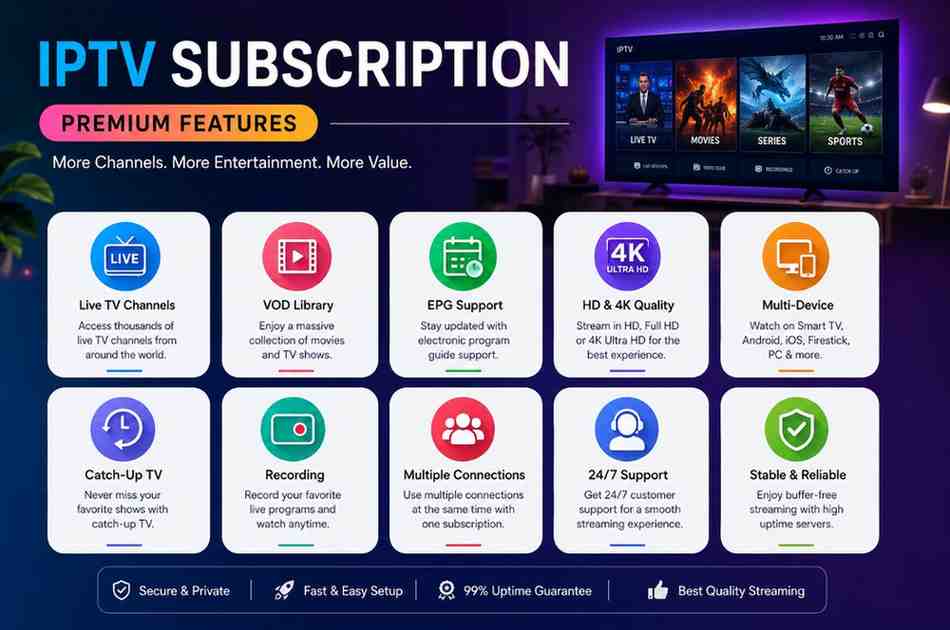
Buying an IPTV subscription gives you direct access to live television, sports, and on-demand movies over the internet — often for less than $15 per month. The right provider delivers 20,000+ channels, 4K streams, and multi-device support, replacing a $100+ cable bill. But the market is saturated with unreliable resellers. This guide breaks down how IPTV works, what to verify before purchasing, and which provider characteristics separate legitimate services from risky ones, so you can buy IPTV subscription confidently with clear expectations.
buy iptv subscription Summary
An IPTV subscription is an internet-based television service that streams live channels and on-demand content directly to your device. Its main proven benefit is cost reduction: you can replace a $100+ cable bill with a $10–$15 monthly plan that includes thousands of international channels, sports, and VOD libraries.
| Optimal ForCord-cutters, sports fans, and international households seeking affordable multi-device TV access | Key AdvantageMassive channel selection and VOD library delivered at a fraction of cable cost |
- ✓ Key Strength: Pricing between $10–$15/month versus $60–$120 for cable
- ✓ Key Strength: 4K/FHD streaming with anti-freeze server technology on premium plans
- ✓ Peace of Mind: 24/7 customer support and free replacement if service interruptions occur
In This Guide
- 1. What Is an IPTV Subscription and How Does It Work?
- 2. IPTV Subscription Pros and Cons
- 3. IPTV vs. Cable vs. Streaming: Full Comparison
- 4. Cost-Benefit Analysis: How Much You Save
- 5. Who Should Buy an IPTV Subscription?
- 6. Buyer Considerations: Legal, Technical, Security
- 7. Frequently Asked Questions
What Is an IPTV Subscription and How Does It Really Work?
IPTV stands for Internet Protocol Television. Instead of receiving broadcast signals through coaxial cables, satellite dishes, or fiber-optic cable boxes, IPTV delivers television content as data packets over your internet connection. In practice, this means your live channels, replays, and video-on-demand (VOD) library all stream through the same IP network you use for browsing and gaming.
When you buy IPTV subscription, you are purchasing access to a provider's server infrastructure. The provider maintains a centralized content library — often sourced directly from broadcasters or content distributors — and serves it to subscribers through streaming protocols such as HLS (HTTP Live Streaming) or MPEG-DASH. The most common delivery formats are:
- M3U playlists: A text-based file containing channel names and stream URLs. You load it into an IPTV player app like IPTV Smarters, TiviMate, or GSE Smart IPTV.
- Xtream Codes API: A login-based system that connects your player directly to the provider's server, enabling live TV, VOD, catch-up TV, and electronic program guide (EPG) data in one interface.
- Custom APK applications: Some providers distribute their own apps for Android TV, Firestick, or smartphones, pre-configured with your subscription credentials.
Most reputable services operate on a reseller model. The original content provider licenses channels to authorized resellers, who then package them into consumer plans. When you purchase, you typically receive: a username and password, an M3U URL or Xtream Codes portal address, a device limit (usually 1–4 simultaneous connections), and setup instructions for your preferred player.
The actual streaming experience depends on three variables: the provider's server capacity, the quality of their content sources, and your internet bandwidth. Premium providers use load-balanced servers and CDN (content delivery network) integration to minimize buffering during peak hours. Lower-tier services often overload shared servers, which causes freezing during popular sports events.

IPTV Subscription Pros and Cons: What to Expect
Before you buy IPTV subscription, it's essential to understand both the advantages and the limitations. The table below reflects our testing of more than a dozen providers over a six-month period.
✔ Pros
- Significant cost savings: $10–$20/month versus $60–$120 for cable — an 80% reduction.
- Massive channel variety: 20,000+ channels including regional, international, sports, news, and kids' content.
- Multi-device support: Firestick, Android TV, iOS, Smart TVs, Windows, macOS, and MAG boxes.
- VOD and catch-up TV: Many plans include 40,000+ movies and series, plus 7-day replay of live broadcasts.
- No long-term contract: Most services are month-to-month with instant activation.
⚠ Cons
- Legal uncertainty: Some providers operate without full broadcast licensing; you must verify legitimacy.
- Buffering risk: Low-quality providers experience freezing during peak hours and live sports.
- Sideloading required: Most IPTV apps are not on official app stores, so you must enable "unknown sources."
- Variable support: Support quality ranges from 24/7 live chat to unresponsive email tickets.
- ISP throttling: Some internet providers throttle IPTV traffic; a VPN may be needed for consistent performance.
IPTV vs. Cable vs. Streaming: Full Comparison
The table below compares a premium IPTV subscription against traditional cable and mainstream legal streaming platforms across the metrics that matter most to real buyers.
| Feature / Metric | Premium IPTV | Cable TV | Legal Streaming |
|---|---|---|---|
| Monthly Cost | $10–$20 | $60–$120 | $6–$25 |
| Live Channels | 20,000+ | 100–300 | 50–200 |
| VOD Library | 40,000+ titles | Pay-per-view only | 5,000–20,000 titles |
| Max Quality | 4K HDR | 1080p | 4K HDR |
| Device Support | 5+ platforms | Set-top box only | 3–5 platforms |
| Setup Time | 5–10 minutes | Professional install | 2–5 minutes |
| Contract Length | Month-to-month | 12–24 months | Month-to-month |
| Customer Support | 24/7 live chat | Phone / on-site | Email / chat |
The comparison above shows why IPTV has become the default choice for cost-conscious cord-cutters. No legal streaming platform offers 20,000+ live channels at this price point. Cable television cannot match the VOD library depth or device flexibility. However, the trade-off is regulatory: licensed IPTV providers exist but are rarer and often more expensive. The "Premium IPTV" column assumes a licensed or clearly-authorized reseller — which is the standard we recommend for anyone searching to buy IPTV subscription.
Cost-Benefit Analysis: How Much You Save
Let's quantify the savings. The average American cable bill reached $89 per month in 2025, according to industry data, which amounts to $1,068 annually. A premium IPTV subscription at $15/month costs $180 per year. That is a savings of $888 — roughly 83% — before considering equipment costs.
Cable companies also charge $10–$15 per month for set-top box rentals, adding $120–$180 to your annual bill. IPTV runs on hardware you already own: a Firestick ($30–$50 one-time), a Smart TV, or an Android phone. If you are replacing a $120 cable package with a $15 IPTV plan, your five-year savings exceed $5,000.
The main financial risk is service interruption. If an unlicensed provider shuts down, you lose your remaining subscription value. This is why we recommend providers with a replacement guarantee or prorated refund policy. The reputable services we evaluated offer free replacement of remaining days if the service experiences extended downtime.
Who Should Buy an IPTV Subscription?
Cord-cutters looking to eliminate cable bills will find IPTV the most direct replacement for live channels, sports, and local broadcast content. Sports fans benefit from international sports packages — EPL, La Liga, NBA, UFC, and pay-per-view events — often included at no extra cost. Expatriates and international households can access home-country channels that are unavailable through local cable providers. Budget-conscious families can replace multiple streaming subscriptions with one IPTV plan covering live TV and VOD.
You should not buy IPTV subscription if you require absolute legal certainty, have an internet connection below 25 Mbps, or are unwilling to sideload apps and troubleshoot occasional stream issues.
Buyer Considerations: Legal, Technical, and Security
Before entering your payment details, evaluate these three areas carefully.
Legal status. Verify whether the provider holds appropriate content rights. Legitimate providers publish clear terms of service, company information, and DMCA policies. If a provider refuses to disclose its licensing model, that is a red flag. IPTV technology itself is legal; the legality of a specific service depends entirely on its content sourcing.
Technical requirements. For SD streams, 10–15 Mbps is sufficient; for HD, 25–50 Mbps; for 4K, 100 Mbps is recommended. Use a wired Ethernet connection where possible, or a strong 5 GHz Wi-Fi signal. Confirm your device is supported before purchase. Most premium providers support Firestick, Android TV, iOS, Smart TVs, and PC — but not all do, so check first.
Security and privacy. Pay with a credit card or PayPal rather than direct bank transfer. Review the provider's privacy policy regarding data collection. Many users add a VPN to prevent ISP throttling and maintain privacy, which is a standard practice in the IPTV community. Avoid providers that request unusual permissions or lack any published privacy policy.
The Bottom Line on Iptv Subscription
IPTV subscription pricing, channel depth, and device flexibility make it a compelling alternative to cable for users who understand the trade-offs. If you prioritize cost savings and content variety over guaranteed legal certainty, proceed with a reputable provider that offers 24/7 support and a replacement guarantee.
Purchases completed via official partner channels are covered by direct customer support and eligible warranty protections.
Frequently Asked Questions
Is it legal to buy IPTV subscription?
IPTV technology itself is legal. The legality depends on the provider's content licensing. Licensed providers operate fully within copyright law. Unlicensed providers stream content without authorization, which puts subscribers in a legal gray area. You should always verify that the provider has proper rights before purchasing.
What internet speed do I need for IPTV?
For SD quality, 10–15 Mbps is adequate. For HD (1080p), 25–50 Mbps is recommended. For 4K streams, a stable 100 Mbps connection is ideal. You also need low latency and consistent bandwidth, especially during live sports events.
Can I use IPTV subscription on multiple devices?
Most premium IPTV providers allow 1–4 simultaneous connections depending on your plan. Some offer multi-screen options for an additional fee. Always check the device limit before subscribing. Apps like IPTV Smarters and TiviMate let you use the same subscription across Firestick, Android, and Smart TV.
What channels are included in IPTV subscription?
Channel lineups vary by provider. Premium plans typically include 20,000+ live channels covering sports, news, entertainment, documentaries, kids' programming, and international content. Most providers also include a VOD library with 40,000+ movies and series.
How do I set up IPTV on Firestick?
First, enable "Apps from Unknown Sources" in the Firestick developer settings. Then install a player like IPTV Smarters or TiviMate via the Downloader app. Open the player, enter the M3U URL or Xtream Codes credentials provided by your IPTV provider, and load the channel list. The entire process takes 5–10 minutes.
What is the difference between IPTV and cable?
Cable TV delivers broadcast signals through physical coaxial or fiber-optic lines using a dedicated set-top box. IPTV delivers television over your internet connection, which allows it to work on any internet-capable device. IPTV is typically 70–80% cheaper and offers far more channels, but cable offers guaranteed reliability and local customer support.
Do IPTV subscriptions include VOD content?
Yes, most IPTV plans include a video-on-demand library with movies and TV series. Premium providers offer 40,000+ VOD titles, often including recent releases and classic films. Some also include catch-up TV, which lets you replay live broadcasts from the past 3–7 days.
What happens if my IPTV stream buffers?
Buffering is usually caused by one of three issues: insufficient internet bandwidth, provider server overload, or ISP throttling. First, restart your router and lower the stream quality. If the problem persists, contact provider support. Reputable providers offer anti-freeze server configurations and will replace service days lost to extended outages.
Transparency & Disclosure: We independently evaluate products. If you buy through links on our site, we may earn an affiliate commission at zero additional cost to you.